


[ad_1]
Contents[Hide][Show]
Perhaps you have heard of a honey mask, and you probably did a yogurt mask at one point. But let me introduce you to a turmeric mask. Rich in antioxidants, this mask helps reduce inflammation, tame acne and improve complexion.
Turmeric mask
Turmeric has many uses, but it is best known for its ability to reduce inflammation in the body. I like to whip golden turmeric milk or a turmeric and cinnamon latte. Sometimes I’ll even brush my teeth with it to help remove the stains (yes, really!).
We can also use turmeric for skin care. A word of warning here though. Turmeric will stain skin, fabric, and some surfaces, so proceed with caution. And no, we’re not going to look like Oompa Loompas after this, but be careful not to go overboard with the turmeric.
Benefits of turmeric for the skin
Just like turmeric fights inflammation in the body, it also helps reduce inflammation in the skin. 2019 research in the journal Nutrients examined curcumin, the main active ingredient in turmeric, for different skin conditions. Researchers have found that curcumin helps with psoriasis, eczema, and other inflammatory skin conditions.
Turmeric has long been used in India and other countries, both for cooking and for skin care. It is traditionally used to lighten the complexion. A 2012 article in Herbal medicine research highlights the ability of turmeric to improve dark spots. Turmeric works by reducing the darker shade of melanin that gives the skin its pigment. It’s ironic because large amounts of turmeric can stain the skin as well. Scientists are even exploring its use in skin tanners!
Because it is anti-inflammatory and antioxidant, there is some evidence that curcumin can help fight sun damage. Turmeric has a protective effect by reducing inflammatory damage to the skin. Over a dozen studies have shown that curcumin has a powerful effect against cancer cells in the skin. This does not mean that rubbing turmeric paste on our skin will cure skin cancer. However, turmeric can help give our skin more of the tools it needs to protect itself from sun damage.
Other Ingredients in Turmeric Facial Mask
Yogurt: Homemade grass-fed yogurt is delicious with coconut granola, or even at home ranch dressing. While turmeric yogurt may not look as appealing as a snack, it makes a great face mask. The probiotics in yogurt support the skin’s microbiome and contain lactic acid. This lactic acid helps fight acne and promotes clear, healthy and youthful-looking skin.
Dairy products (and coconuts) also contain lauric acid, a fatty acid. Researchers have found that when lauric acid is combined with the curcumin in turmeric, it creates an acne and inflammation powerhouse. For those with dairy allergies, coconut milk or coconut milk yogurt will also be part of this recipe.
Oats: Oatmeal is another really good ingredient for soothing the skin. While true colloidal oats are impossible to make at home, we can still harness the benefits of oats for skin care. The oatmeal powder helps thicken the mask to stay put on the skin and soothe inflamed or itchy skin.
You can see how i do “Colloidal oatmeal” at home here. It is not the same as oatmeal, the beneficial bran of which is removed. This turmeric face mask can also work as an exfoliant since the oats help gently remove dead skin cells.
Raw honey: And of course, we can’t forget about raw honey. Raw honey is a superfood for the skin that helps soften and cleanse. The naturally antibacterial properties of honey make it particularly useful for skin imperfections. Raw honey also helps speed healing of cuts and burns and can help damaged skin recover faster.
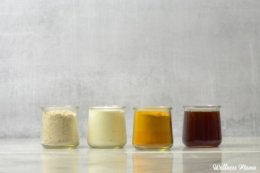
Turmeric mask
This soothing mask helps calm irritated skin while brightening and softening.
Instructions
-
Mix all the ingredients together until smooth.
-
To use, apply liberally to the face. Wash off after about 10 minutes.
Notes
I kept the turmeric low so it wouldn’t stain the skin. However, due to variations in skin tone, you may want to do a patch test on the back of your hand first. Reduce turmeric powder if necessary.
More mask recipes to try:
What are your favorite ways to use turmeric? Leave us a comment and let us know!
Sources:
- Arct, J. et al. (2014). Evaluation of the skin coloring properties of Curcuma Longa extract. Indian j pharm sci. 76 (4): 374–378.
- Liu, CH and Huang, HY (2013). Anti-propionibacterial activity in vitro by vesicle system containing curcumin. Chemical and Pharmaceutical Bulletin, 61(4), 419–425.
- Vaughn, AR, Branum, A. and Sivamani, RK (2016). Effects of turmeric (Curcuma longa) on skin health: A systematic review of clinical evidence. Herbal medicine research: PTR, 30 (8), 1243-1264.
- Vollono, L. et al. (2019, September). Potential of curcumin in skin disorders. Nutrients, 11 (9): 2169.
[ad_2]

